
What’s the Best Way to Invest for Your Grandchildren?
Comparing shares, investment bonds, family trusts and superannuation
Many grandparents tell me they do not simply want to leave a larger inheritance after they are gone.
They would rather see their grandchildren benefit while they are still here to share in the experience.
Whether the goal is to help with education costs, contribute towards a first home deposit or simply give the next generation a stronger financial start, more families are exploring ways to invest for their children and grandchildren.
In fact, it's one of the most common questions I hear:
“Chris, we’d like to put some money aside for the grandkids. What’s the best way to do it?”
It's a great question.
The challenge is that there isn't one "best" option. The right strategy depends on your goals, timeframe, tax position, family circumstances and how much control you want to retain over the money.
The good news is there are several effective ways to do it.
The bad news? Ask your accountant, neighbour, golf partner and the bloke at the barbecue, and you'll probably get four different answers.
Let's cut through the noise and look at the main options.
In a Hurry?
If you're considering investing for grandchildren:
Investing in your own name offers maximum flexibility and control.
Investment bonds can provide tax-free access after 10 years if the rules are met.
Family trusts may suit larger family wealth and estate planning strategies.
Superannuation can provide significant tax advantages but limits access to the money.
The best option is usually determined by your goals rather than the investment itself.
The Biggest Mistake People Make
When this topic comes up, most people immediately ask:
“Which option gets the best return?”
That's a fair question, but it's often the wrong place to start.
Over the years, I've found the best outcome is usually determined by three factors:
Who controls the money?
How is it taxed?
When can it be accessed?
The investment itself is only part of the story.
A structure with slightly lower returns may still produce a better long-term outcome if it delivers tax benefits, better estate planning outcomes or greater certainty around who ultimately receives the money.
That's why I encourage clients to start with their goal first and the product second.
Option 1: Invest in Your Own Name
For many families, the simplest option is also the one that works best.
This involves investing in your own name and mentally earmarking the money for your grandchildren.
The biggest advantage is flexibility.
You retain complete control over the investment and can decide:
How much to invest
When to contribute
When to gift the money
Which grandchild receives what amount
Whether circumstances justify changing your plans
Life rarely goes exactly as planned. Having flexibility can be incredibly valuable.
The downside is taxation.
Any investment earnings and capital gains are generally assessed at your marginal tax rate. Depending on your income, this can reduce the amount ultimately available for your grandchildren.
However, for many families the flexibility outweighs the tax cost.
Best suited to:
Grandparents wanting maximum control
Families with uncertain timeframes
Investors who may need access to the funds
Smaller to medium balances
Option 2: Investment Bonds
Investment bonds are often overlooked until people specifically start researching investments for children or grandchildren.
They sit somewhere between a traditional investment and a tax-effective savings vehicle.
An investment bond allows you to invest in a professionally managed portfolio while benefiting from a unique tax structure.
If held for at least 10 years and the contribution rules are followed, withdrawals can generally be received tax-free.
Many investment bonds also allow ownership to transfer to a child at a nominated age, making them attractive for grandparents who want money set aside specifically for a grandchild's future.
That could be for:
University expenses
A first home deposit
A business venture
General financial assistance in early adulthood
The trade-off is that investment bonds typically have higher fees than direct investments, and tax is paid internally within the bond.
As a result, investment performance may appear lower than other structures in some periods.
However, focusing solely on recent returns can miss the bigger picture.
If your goal is to build wealth over 10 years or longer and eventually transfer it to a grandchild, the tax-free treatment can be a very valuable feature.
Best suited to:
Long-term savings goals
Structured gifting strategies
Education funding plans
Grandparents wanting a dedicated investment for a specific child or grandchild
Option 3: Family Trusts
For larger balances or more sophisticated family wealth planning, some clients ask whether they should use a family trust.
This is particularly common where a trust already exists.
A family trust can provide flexibility around who benefits from investment assets in the future and may form part of a broader tax, asset protection and estate planning strategy.
Trusts can also allow grandparents to retain control of investments while creating a structure that may benefit multiple children and grandchildren over time.
For example, some families may want one pool of assets that can be used to help multiple grandchildren with education costs, business opportunities or housing assistance as needs arise.
The key word with trusts is flexibility.
The downside is complexity.
Trusts involve:
Establishment costs
Ongoing administration
Annual tax returns
Additional record keeping
Professional advice costs
They also don't automatically provide tax benefits for children, as special tax rules apply to minors.
For some families, a trust can be an outstanding long-term wealth planning tool.
For others, it simply adds complexity without delivering enough additional benefit.
Best suited to:
Larger investment balances
Families who already have trusts
Multi-generational wealth planning
Asset protection and estate planning considerations
Option 4: Superannuation
This is the option that often surprises people.
Rather than investing specifically for grandchildren, some grandparents choose to direct extra savings into their own superannuation.
At first glance, that sounds unrelated.
But there is logic behind it.
Super remains one of Australia's most tax-effective investment structures.
Investment earnings are generally taxed at a maximum rate of 15% in accumulation phase and can often be accessed tax-free once retirement conditions are met.
The obvious drawback is accessibility.
Unlike other options, the money generally cannot be accessed until a condition of release has been satisfied.
So if your goal is to help a grandchild buy their first home next year, super clearly won't work.
But if you're looking at a longer-term intergenerational wealth strategy, strengthening your own retirement position may ultimately increase the wealth available to pass on to future generations.
Sometimes the best way to help your family is first ensuring your own retirement is secure.
Best suited to:
Long investment timeframes
Retirement planning
Estate planning
Intergenerational wealth strategies
Does Structure Matter More Than the Investment?
Many investors spend hours comparing investment funds.
Far fewer spend time comparing ownership structures.
In many cases, the structure can have a larger impact than the investment itself.
To illustrate the point, I recently compared three high-growth investment options held through different structures.
As at 31 August 2026:
Personal investment account (32% marginal tax rate plus Medicare Levy): 12.67% p.a.
Superannuation: 12.60% p.a.
Investment bond: 10.12% p.a.
Past performance is not a reliable indicator of future performance.
However, the comparison highlights an important lesson:
The structure you choose can be just as important as the investment you choose.
Returns are only one piece of the puzzle.
Taxation, flexibility, control and future access to the money can all significantly influence the end result.
Comparing the Main Options
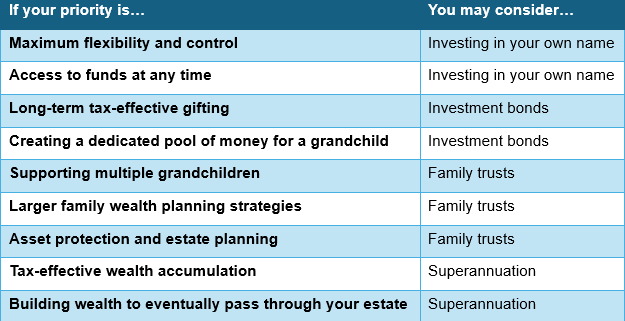
Start With the Goal, Not the Product
Over the past few years, I've noticed more grandparents asking this question than ever before.
I suspect that's because many can see the financial challenges facing younger generations.
Property prices remain high.
Education costs continue to rise.
The cost of living isn't getting any cheaper.
As a result, many grandparents want to do more than leave an inheritance at some point in the future.
They want to create opportunities today.
Some families start by investing $50 per week.
Others contribute lump sums when grandchildren are born.
Neither approach is right or wrong.
What matters is having a clear objective.
Are you trying to:
Help with a first home deposit?
Fund private schooling or university costs?
Create a nest egg for adulthood?
Help multiple grandchildren equally?
Build long-term family wealth?
Once the goal is clear, selecting the right structure becomes much easier.
Final Thoughts
A few thousand dollars invested today may not seem life-changing.
But over 10, 15 or 20 years, regular contributions combined with investment growth can become a meaningful gift.
More importantly, it can create opportunities that might otherwise not exist.
There is no single best way to invest for grandchildren.
The right solution depends on your family, your goals, your tax position and how much flexibility you want to maintain.
And despite what the bloke at the barbecue reckons, the answer is rarely as simple as "just buy this."
The best strategy is usually one that balances taxation, control, flexibility and long-term family objectives.
Thinking About Investing for Your Grandchildren?
If you are considering putting money aside for children or grandchildren, we can help you compare the advantages and trade-offs of each option and identify the structure most likely to support your family’s goals over the long term.